

This post is sponsored by Le OFF Paris: The unofficial guide to the official Paris

As an initiative of Vinexposium, Le OFF is a selection of addresses curated by journalists, critics, and industry insiders who care as much about what they drink as about what they eat. You can discover their selection here.
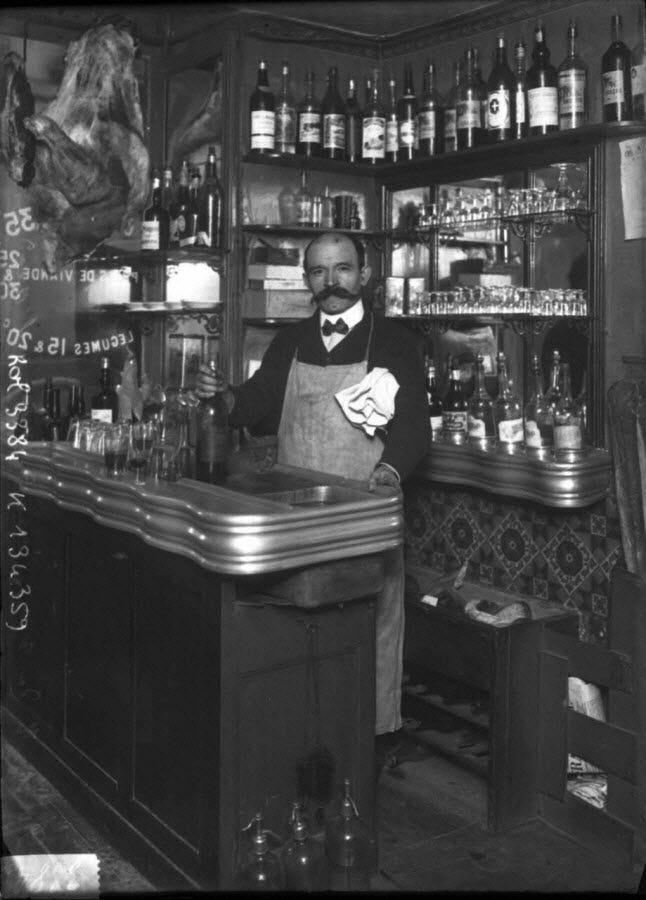
A proper education in eating and drinking can only be achieved with the right constraints. At least that was the opinion of A.J. Liebling, Anthony Bourdain’s favorite chronicler of the food in Paris. Liebling’s prosaic plume gave even his most mundane convictions a pontifical sense of authority. (And his knack for squeezing thousands of entertaining words out of these convictions is nothing short of amazing). But on these matters of pedagogy, I happen to agree wholeheartedly.
“If… the first requisite for writing well about food is a good appetite,” Liebling writes in Between Meals: An Appetite for Paris, “the second is to put in your apprenticeship as a feeder when you have enough money to pay the check but not enough to produce indifference to the size of the total. The optimum financial position for a serious apprentice feeder is to have funds in hand for three more days, with a reasonable, but not certain prospect of reinforcements thereafter.”
Financial planning for the apprentice eater could be debated until blue in the gueule, but the point is well taken. Had David enjoyed the same stature as Goliath, he’d never have honed the skills for his triumphant sling.
Likewise, the young eater with bottomless pockets, taking refuge in the ‘top shelf,’ is spared the uncomfortable process of developing their taste. They may otherwise discover nuances in the ‘second rate’ that they actually prefer, or some deficiencies that accentuate the godliness of the ‘first rate.’
“
I was a student, in the highly generalized way, at the Sorbonne, taking targets of opportunity for study. Eating soon developed into one of my major subjects. The franc was at twenty-six to the dollar, and the researcher, if he had only a certain sum—say, six francs—to spend, soon established for himself whether, for example, a half bottle of Tavel supérieur, at three and a half francs, and braised beef heart and yellow turnips, at two and a half, gave him more or less pleasure than a contre-filet of beef, at five francs, and a half bottle of ordinaire at one franc.
“
We see, from this example, that Liebling studied in a bygone Paris. Any restaurant serving braised beef heart and yellow turnip in 2026 would quickly become my favorite restaurant. We also see how crucially wine factors into his calculus. The apprentice would do well to dedicate at least as much focus on what they drink as what they eat. Part of the reassurance of food is that one can look at a turnip, taste a turnip, and be pretty damn sure it’s a turnip. Distinguishing between Liebling’s Tavel supérieur and ordinaire, on the other hand, requires a different level of discernment.
I am still blissfully novice in my explorations of wine, and thus I rely, as Liebling did, on guides to facilitate my discoveries. The amount of credence a guide deserves, in Liebling’s opinion, hinged largely on who was behind it. One would hope its authors were authorities on the subject matter, rather than on, say, tires.
With that in mind, I confidently turn to the sponsor of this post, Le OFF, when I want to be absolutely sure to drink at least as well as I’ll eat.
A quick scroll of the guide last week led me to Duvin, a traditional bistrot with a handsome devanture on the Rue Jean-Baptiste Pigalle. It was only upon translating the restaurant’s name, ‘of the vine,’ that I realized (or perhaps remembered) the bacchanalian origins of the word ‘divine.’
I took my seat at a small table that nearly blocked the passage of the waiter and maître d’. There in the center of the action, like in the front row of a lecture hall, I’d be able to observe their swift movements and overhear the counsel given to neighboring tables.
My friend and I decided on a terre et mer approach to our feast. He’d order the terrine followed by a cœur de filet au poivre (at 32 euros, quite the bargain for Paris these days), while I’d go for the prawns and then monkfish. The most important lesson I derived from the meal came when I asked for a white wine with a belle rondeur to accompany my seafood. I would have defaulted to a white from burgundy had it not been for the wisdom of our waiter, who steered me instead towards a white from the Rhone. You can watch my video review here for the full experience.
I hope all my Parisian readers are staying cool.
See you in a couple weeks,
Max
Max, You might like Waverley Root's 1958 book, "The Food of France". I can lend it to you!