

From behind her windshield, a woman’s eyes followed us along the crosswalk, only an arm’s length from the hood of her car. She looked vaguely familiar, but who could she be? We didn’t know anyone in town. She rolled down her window, revealing her face more clearly.
Oh right! I unzipped my jacket to show her the green, merino wool sweater I was wearing.
“You’re lucky you bought that from me, otherwise SPLAT!” She demonstrated the collision with her fist crashing into her palm, before unleashing a warm belly cackle, waving au revoir as she drove off.
“So funny. She must have just closed up for the day,” I said to Eva. I had purchased the sweater—a traditional mariner’s garment, still made in the region, with four buttons running down the left shoulder—off the clearance rack of her boutique in downtown Roscoff, an old port town in the northern Finistère department of France, right at the mouth of the English Channel. The bus from Morlaix had dropped us off just hours before, and we had been aimlessly exploring the town’s historic center, until the sweater caught my eye through the shop’s window.
I looked in the mirror outside of the changing room in the back of her narrow store, stunned that the sleeves fit my nearly two-meter wingspan. Eva, after expressing her approval, tugged my arm, directing my attention to a far more stunning sight. To my right, a floor-to-ceiling, wall-to-wall window revealed an unobstructed view of the water, dominated by the Île de Batz (Island of Batz), just a stone’s throw—if you’ve got the arm of Yoenis Céspedes—from the shore.
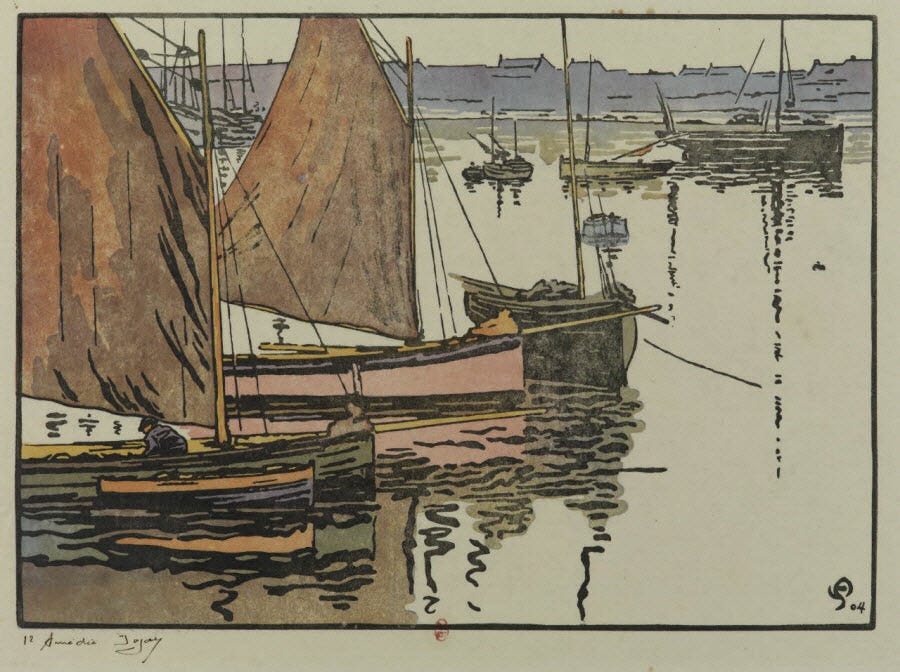
In the foreground of the sound, fifty meters from where we stood, were sailboats standing on their keels, propped up by a stilt on either flank, and many small fishing boats lying on their sides in the wet sand like a hundred dead fish. The dark sludge, dotted with white seashells and splotches of purple algae, glistened a platinum sheen in the evening light. I half expected one of the beached boats to give a final desperate flop.
This part of the French coast experiences some of the biggest tidal fluctuations in Europe. The next morning, the boats would, once again, be full of life, rocking back and forth in meters deep water. At least they had better be, I thought, because that flat sand bar, enclosed by a long stone port, was where we were scheduled to board the 10:45 ferry for the island, and unless it was something like Boston’s amphibious duck boats, it wasn’t going to make it over there.
Île de Batz
The tide did rise, thank God, because the ferry, as I suspected, was not amphibious. It was a tiny little thing, with capacity for no more than thirty people inside its cabin. The only vehicles on board were a Yamaha XMax scooter and a few bicycles out on the front deck, which bore splashes of sea spray each time the bow crashed into the whitecaps.
Only about 450 residents hold down the island during the off season. The summer folk, it seemed, had scheduled renovation projects during that time, as many of our fellow passengers—carrying tools and wearing sturdy shoes—were headed for jobsites. The rest were islanders, hauling back bags of toilet paper and other supplies from the continent.
It would take us roughly four hours to walk the perimeter of the island, starting out westward from the southern port, through the small village: a cluster of granite cottages with peaked slate roofs and medieval looking doors, barely big enough for a hobbit. Some palm trees spilled out of their gardens and over the tall stone walls enclosing them.
The Île de Batz, the locals assured us, is home to a “micro-climate” that resembles the Mediterranean more than northwestern France. As proof, an exotic botanical garden was established in 1897 at the east end of the island, which is now home to 1700 plant species from around the world.
“My ass,” I thought, staring up at the ominous grey clouds. The climate, to that point, had been more moody than micro, and I was happy to have my new sweater. We continued past the village, beyond its protective walls, where we met a fierce wind coming in from the sea, strong enough to whisk Eva, had she been holding an umbrella, clear across the channel to Cornwall.
We strolled down a narrow dirt path that separated the wild coast from the pastures. To our left, steel blue boulders rolled down the bluffs, framing crescents of white sand beaches. To our right, horses grazed, unfazed by the gusts, in a rippling expanse of tall grass.
“Look!” Eva pointed to balls of seafoam floating by our faces and into the fields. Our eyes retraced their flight down to a frothy bath that had formed in a cluster of rocks. The wind was stirring it up into a tourbillon, blowing the foam onto the island like a child blowing bubbles. “It looks like Aphrodite is about to rise up!”
She kindly explained her reference, after I reminded her of my American public school education, and we continued down the path—enchanted, stupefied—towards the light house on the island’s west end, the only structure in sight, barring the occasional cottage or abandoned granite barn.
It wasn’t until we rounded the lighthouse and reached the island’s northern shore—along which rows of purple artichokes grew in small parcels of rich black soil—that I broke away from the scenery’s trance and began to dream of the upcoming event, the very reason (besides some quality R&R) for our visit to Roscoff: Eva’s birthday dinner at NORI, a three-toques, one-star Michelin restaurant in an old merchant’s manor, now an Inn & Spa in the Relais & Châteaux collection. Artichokes, being an emblematic crop of the region (weird, I know, but that’s micro-climates for you), would surely appear on the menu.
Roscoff
The return ferry, lacking wheels, had to drop us at the low tide port on the far end of town. As we walked back into the center, we noticed a plaque marking a house where Alexandre Dumas spent the summer of 1869 (Bryan Adams fans rejoice) writing the “Oignon” chapter of his Grand Dictionnaire de Cuisine.
The penman of The Three Musketeers and The Count of Monte Cristo, like many French writers, was also a bonafide gastronome. But Dumas’s arrival in Roscoff likely had more to do with seascapes than with alliums. In fact, the town’s now famous sweet pink onions were previously unknown to the writer. “If, to be able to write about a subject, one must have the subject in view,” he wrote, “then it is by providence that I arrived in Roscoff at the moment the word ‘onion’ would appear under my pen.”
Today, on the town’s main drag, there’s mention of onions almost everywhere you look. The butcher sells saucisson à l’oignon de Roscoff, while the grocers sell Roscoff onion jam and Roscoff onion soup. Even the gift shops hang bunches of them alongside refrigerator magnets and alphabetized first-name souvenir bowls.
A sign outside the Maison des Johnnies recounts the history of the onion merchants of the 19th century who loaded their bicycles with the pink-skinned globes, sailed to England, and rode door to door selling their crop. Many of them bore the popular Breton firstname Yannick, which the Brits anglicized to “Johnny,” giving them their nickname, “the Onion Johnnies”.
Today the oignon de Roscoff is integral to the local DNA. The product is protected by an AOP (appellation d’origine protégée) and venerated in an onion festival held in Roscoff every August.
There was, however, a Roscoff before onions. One could even say that, just like Dumas, the variety arrived by divine providence. Legend tells of a Capuchin monk returning from a stay in Portugal with a delectable onion of a rose hue. This story is celebrated but unverified by The New York Times. (I don’t write for The New York Times, but still, I don’t think they have verified this story.)
In any event, the pink onion couldn’t have chosen a prettier place to settle. We circled the main square around the Église Notre Dame de Croaz-Batz, a baroque, granite church, with fresh emerald moss growing on its slate shingled roof, and headed back through town, past impeccably maintained stone houses and centuries-old manors, towards our hotel, home to NORI, where we’d dine the following evening.
Breakfast at the Hôtel Brittany & Spa
Dinner—if the hotel’s breakfast was any indication—was going to be fantastic. We started the day, Friday, March 13th—Eva’s birthday—with hot dashi poured over a small bowl of smoked pollack, radish, and green onion. Chef Loïc Lebail, a Brittany native, often travels to his wife’s home country of Japan. Her culture has strongly influenced how he uses the fruits of his home region.
I know what you’re thinking. The Franco-Japanese culinary melange is about as common a mix as golden doodles, but the compatibility can’t be argued, especially in the Finistère, where seaweed has long been used as a fertilizer, but only recently as food.
At the buffet-spread next to the dashi bowls sat a delicious array of mostly traditional charcuterie, like paté de tête, paté en croûte, and smoked pork belly, along with some modernized classics, like pork terrine with wakame, or seaweed tartare.
What really intrigued me though, past the egg station and across from the Breton pastries—crêpe, kouign-amann, far breton—was a selection of unfamiliar fermented dairy products. Gros lait, lait ribot—what are these things? The first was thick and custardy. The latter bubbled in its carafe. Both were porcelain white. Having suppressed the urge to try them—perhaps for lack of courage, or maybe for lack of room—I went on with my day, hoping they’d reappear at dinner.
Dinner at NORI
The maître de maison, in his great wisdom, suggested we enjoy an aperitif in the hotel’s bar before proceeding to the dining room. He must have sensed we were thirsty, because our coupes of extra brut vanished like liquid nitrogen poured into a sauna, and I had to fight the urge—while he escorted us to the restaurant—to tell him there was a hole in my glass. I’m only 27. That’s still too young for such remarks. Once I hit thirty, though, I’m letting ‘em rip.
He led us past the massive fireplace where a few logs burned, to a round table dressed in thick white linen in the back corner of the already full dining room. Had this been breakfast, we’d have requested a table in the front with a view, but the stone arched windows that so beautifully framed the seascape that morning had become black mirrors, faintly reflecting the warmly lit tables. For the first time, we noticed the room’s beauty and scale: the meticulous stone masonry, the long, serpentine beams holding up the ceiling. Then a server arrived with…
Les Amuse-Gueules:
Three tartelettes…
… arranged in a row. We started, as instructed, on the left with what tasted like the world’s greatest “French onion dip”—a shiny white globe of lait ribot (the bubbling stuff from breakfast, which turned out to be the regional term for buttermilk) topped with Fried Roscoff onion. We worked rightward to another shiny ball—maroon now, instead of white—of crème de boudin noir with something like Chinese five-spice and topped with translucently thin Granny Smith slices. The liquified boudin rested on a crispy snail-like chip, made from tightly rolling a buckwheat crêpe and cutting it into thin slices. I could have ended my evening with those flavors and been satisfied, but I opened my heart and my mouth to the final delight: smoked pollack, marinated kombu, and red currant on a tapioka chip. The bar had been set, and it was scraping the ceiling.
Bouillabaisse Squid…
… arrived in a hand crafted ceramic bowl. The staff didn’t actually acknowledge any relation to bouillabaisse, but this dish was an obvious wink to Marseille. Supple rings of poached squid sat in a viscous rockfish broth with buckwheat kernels, fennel, and a dollop of aioli at the bowl’s base. Wowed, I wondered how they would keep this up.
Red Mullet Maki
With our thumb and our index fingers, we pushed a rectangular sheet of nori (hey, that’s the name of the restaurant) into a small mass of fish and puffed buckwheat, which unfortunately overpowered the garnishes: gellified ponzu and raspberry powder. A slight dip, but our gueules were nonetheless amused by these impressive undercards.
The Main Event began with…
Foie gras…
… in the form of a millefeuille, layered with powdered pain d’épices, and topped with a mango and maracuja condiment, bottarga, and a foie gras macaron. Any intelligible commentary from Eva and me ceased, giving way to a concert of mmmm’s and oh my god’s. We enjoyed the heavenly brick, morsel by morsel, on a wedge of toasted country pain au levain.
Scallops snacké…
…or, lightly seared, were served with a steaming sauce of fish stock and milk (just trust it), and parsnips prepared two ways: puréed, and fried in the form of a nest. Sporadic dots of citrus cream brightened the otherwise rich mollusks.
Eva, who was still nursing a glass of Chablis, was now bonding with a young man on the service staff over their shared love for Lana del Rey. I used the opportunity to chat with the sommelier, who suggested I fill my dry glass with a certain red Burgundy. That would be the best match for the rest of the menu and would even go nicely with…
The best damn fish I’ve ever had
A nearly translucent pollack nacré (meaning, more or less, gently poached in butter) flaked away into delicate chunks, perfect for dragging through the limequat cream and vanilla beurre blanc, a nod to Lebail’s old mentor, Alain Senderens, who famously served lobster à la vanille at his three-star Paris restaurant, now home to Alain Passard’s Arpège.
A circular film of gros lait (that’s the other novel dairy from breakfast, which turned out to be fermented curds) covered golden brown cauliflower, Roscoff onions, and more gros lait, this time in its brut form. Both Eva and I needed a moment to gather ourselves after what was easily the best fish of our lives, which is why the…
Côte de Veau…
… topped with sea snails, felt like a sick joke. I could handle one superlative dish, but two back to back proved dangerously intoxicating. To merely describe the veal as “perfectly cooked” would be an insult to the chef. I couldn’t tell if it had been reverse seared or cooked sous vide in a bath of holy water, but the veal was so flavorful that Eva was convinced it was lamb. A jus à l’orange dressed the dish, along with seaweed tartare nestled in a brussel sprout leaf, artichokes (there they are), Roscoff onions, parsnip, and white carrot.
I’ve heard from chefs that main courses are often less interesting than starters due to the constraints, or rather the demands—the need for a protein, a vegetable, a starch—but Loïc Lebail’s main courses taste as unconstrained as a Fellini movie, with all the narrative beats of a Tarantino flick. And like so much great cinema, Lebail’s last act was decidedly…
Bittersweet
“Look how the angles of this coastline fit right into Rhode Island,” I had been rambling to Eva earlier that day, analyzing Google Maps on my phone. “I bet you they were touching back when this was still pangea. You could’ve walked a mile that way,” I pointed to the beach, “and ended up right in downtown Westerly.”
“Yeahhh… ya know… maybe!”
It turned out, not at all. But that impressively stupid statement reflected the rare feeling Roscoff awakened in me: the feeling of being home, of wanting to stay put, in a place we had never been. Perhaps the village struck that elusive balance—the one so revered by MBAs and marketing executives—of novelty and familiarity. Or maybe these two days had just been a beautiful respite from the daily striving and the constant preoccupation of our lives in Paris. Wouldn’t it be nice to stay here?
Eva, that afternoon, had been indulging in fantasies of her own, scrolling through local real estate listings. “Oh my god, only a million for this one on the Île de Batz,” she showed me an old granite house with a walled garden and water views.
“That ain’t bad.”
“Or 175,000 for this little house in Roscoff, look how cuuuuute!”
Before dinner, we took a walk by the smaller house, ten minutes inland from the church. We fantasized how we’d spend our days there. All the books to read, the coastline to explore, the vegetables to grow, the recipes to make, the stories to tell. Anything to buy more time there, more freedom.
…
With a heartfelt smile, the maître de maison brought us our prédessert, bid us goodnight, and left the stage. Only a couple of staff members stayed in the dining room to look after the remaining couples, now giggling with bellies full of wine.
We cracked our spoons through the honeycomb tuile, into sweet cream and a delightfully bitter sorbet of buckwheat and hops. Like a melancholic McCartney melody, I wanted to eat it over and over.
We hesitated before breaking into the main dessert, a trompe l’œil, which, as little Carmine will tell you, means “fool the eye.” The longer we stared at the rock-like sculpture of hazelnut and chocolate, the longer our fantasy would last. But the tonka bean ice cream was melting. We had no choice but to dig in.
“C’est comme des petits oiseaux !” — (“They’re like little birds!”) Eva exclaimed to the server when she brought us four little mignardises—mango cream and black sesame, a lemon tartlet, a pina colada choux, and a divine chocolate ganache—aligned on a branch of drift wood. She was feeling slightly less inhibited after two glasses of wine.
These mignardises at these fine dining restaurants might seem superfluous; and, at times, they are. But that night they were crucial. It’d have been too hard to leave without one last little song, something sweet to help us see the bright side. And so we savored them, contemplating how we’d spend the next morning before our departure. “Maybe we can go back to that lady and get another sweater!” Eva suggested. After all, she had been kind enough to spare us.


I know Roscoff! Amazing antique store there. next time, skip over to Loquirec, too
Beautifully written!