

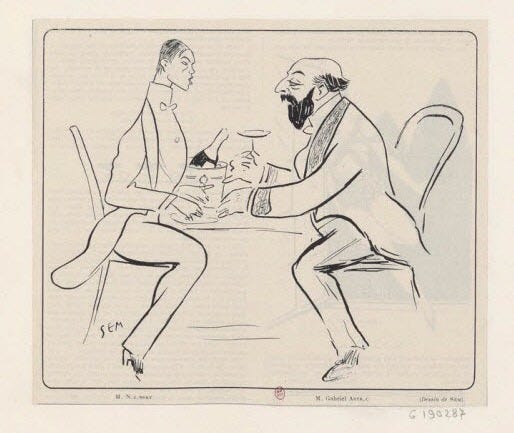
Oh, how I dream of the old, gluttonous Parisian lunches one reads about, where morteau sausage would follow pike and Nantua sauce, would follow two dozen oysters; and where the Krug flowed freely until it became Pétrus. The kind of lunch that was often enjoyed by A.J. Liebling, the famously rotund New Yorker staff writer of the 1940s and 50s, who regularly sojourned in Paris following his year at the Sorbonne, accompanied by his bon vivant friend, playwright Yves Mirande.
Duos of such eccentricity and appetite are no doubt dwindling. But I know a pair of pals still capable of a similar kind of luncheon. One is an American chef who came up in the New York of the old Four Seasons, and the other is a Frenchman dealing in rare metals. On occasion, they can be found in the restaurant of Cave Legrand, inside the Galerie Vivienne, flooding a midday’s meal with volumes of wine (Puligny Montrachet, Saint-Joseph, etc) totaling somewhere in the triple digits, beginning with a 3 or a 4 and punctuated by a cl., before continuing a day’s work in full form. Impressive stuff.
For me to do likewise would mean cancelling all remaining appointments of the jourd’hui, as well as any obligation to stand upright the following day. Those two are, however, a few decades my senior. My generation—and I fully include myself in this indictment—is of a far meeker constitution.
Not only would our wallets struggle to withstand such indulgence, but the inundation of animal fat and alcohol risks tipping our precariously optimized gut flora and circadian rhythms off balance, sending us into a catastrophic downward spiral.
That doesn’t mean we don’t want to live and eat well on a weekday, like Liebling and Mirande. It just means we need to be a bit more judicious about our consumption.
Luckily, plenty of establishments, especially in the Eastern half of Paris, cater to our modern sensibilities/dietary fragilities. Finding one that isn’t insufferably global—on the other hand—while very possible, isn’t always that simple.
To be clear, I happily embrace the international influence that pervades many modern restaurants. I like dukkah as much as the next guy. I just want to know that I’m in Paris. I need, at minimum, some perceivable trace of local culinary history. Otherwise, my brittle justification for living here (rather than, let’s say, St. Paul, Minnesota) will crumble like a tea biscuit dunked a nanosecond too long.
At a good neo-bistrot, the decor should be recognizably Parisian. They might even offer a selection of casse-croûtes to go, like the old provençal cafés. Or maybe they work primarily with local produce and responsibly raised French poultry. In other words, maybe they’re something like Le Rigodon, 10 Rue des Trois Bornes, 75011 Paris.
Lunch menus here, as indicated by white lettering on the vitrine, start at a merciful 21 euros. If you want dessert, which Liebling would, and I certainly do, you’ll have to mine your pockets for 4 euros more.
I stepped through the doorway of the green devanture into a small room of sandblasted, Lutetian limestone, lined with wooden banquettes and tightly packed tables. A small épicerie section offering kombuchas, conserves, and oils claimed the back wall.
Before I could finish my scan of the cadre, a tall, black-haired Frenchman—who turned out to be the owner, Côme, with whom I’d exchanged emails—walked into my gaze, commandeering my attention with a string of pleasantries until, suddenly, I found myself seated in the corner, staring at a chalkboard menu propped up on the seat across from me. I hung onto every word as Côme read aloud from the board, for fear of being left alone with his illegible chicken scratch (bistrottiers and pharmacists share the same handwriting).
La France, while modernized, was certainly present on the menu. I ordered a cuisse de canette (young duck) confite, to be preceded by a red beet salad with feta cream and lime leaf pesto.
A bon vivant like Liebling would never have dreamt of drinking only water with a French meal. (In fact, I’m actually not sure he ever drank the stuff.) For Liebling, at least as much pleasure must be derived from the contents of the bottle as from the contents of the plate. I’m just happy he’s not here to read that the pleasure I derived was not from wine, but from a sublime bottle of fig leaf kombucha.
Fig leaves (and fruit leaves in general) are among my favorite of the current culinary trends. They provide a mystifying blend of aromas, as floral and fruity as they are nutty and toasty. The lime leaf pesto dressing my beets, with its warmth and zest, proved similarly tasty.
Beyond just delighting the palate, each bite of my entrée energized me. I felt as nimble as Floyd Mayweather by the time I polished my plate, ready to shoulder roll any punches the afternoon might throw. The real test, though, came from the main course. I feared I was one cuisse de canette away from feeling more like Eric “Butterbean” Esch.
But this was not your typical Gascon duck dish. The leg—instead of being served with something like sautéed potatoes and lardons—shared the plate with beautifully roasted root vegetables and a lightly charred wedge of radicchio, drizzled with a sort of caramelized orange glaze. I cracked through the fatty skin with the knife in my right hand, pulling away succulent shreds of meat with the fork in my left. Scarcely do I remember eating duck so perfectly confited.
If I’m still feeling this light in ten minutes, I remember thinking as my dessert (a wedge of grapefruit cardamom cake) arrived at my table, I’ll be absolutely shocked.
I worked down the wedge, morsel by morsel, and watched the minute hand with growing disbelief as it circled the dial on my wrist, until, finally, I reached the last bite. I took one last sip of locally roasted espresso, gobbled the remaining bit of sponge, and bounced out of my chair. It’s official, I whispered under my breath, the perfect lunch is upon us.
As you may have guessed, I’m reading through A.J. Liebling’s Parisian memoirs and absolutely loving them.
A huge thank you, as always, to my paid subscribers for your support! Now back to Roland Garros.
See you in a couple weeks,
Max
The globalisationing of French cuisine has been here for a while and I suspect it will remain around for a good deal longer…and that is fine. Truth to tell, as I get older I find myself growing more nostalgic for the no holds barred classics. Old school indulgences, as it were. But done well, which can be challenging to find in restaurants at a reasonable price these days…so, I find myself adventuring in 4 day long shopping, prepping and cooking extravaganzas with old school favourites leading to an indulgent Sunday lunch for family and my old friends with plenty of great wines, a generous cheese board and digestifs of repute. La bonne chère traditionnelle remains a living patrimony close to my heart and soul, worthy of celebrating…if I want innovation or creativity I dine out.