

Over the course of my life, I’ve probably spent as many cumulative minutes watching this single video of Jacques Pépin making an omelette as I have watching Martin Scorsese’s entire filmography. (I’ve seen Goodfellas no fewer than 14 times.) That video was one of my main cultural reference points for Paris before I first came in 2018.
Unsurprisingly, I expected to find omelettes at every café, bar, and bistrot. But as I reflected in my last post, the omelettes have not materialized as hoped. Where have they gone? Did they leave France the same year as Monsieur Pépin? Or perhaps, they were never here in the first place?
Luckily, after sending out that post, I received some much needed validation from my Parisian friend Sabine. She told me I was totally justified in my mourning. The “quiet disappearance of the humble omelette,” as she called it, was real. But like any good friend, she didn’t deliver the bad news without a glimmer of hope in the form of an address.
Café de la Mairie, Paris 6ème
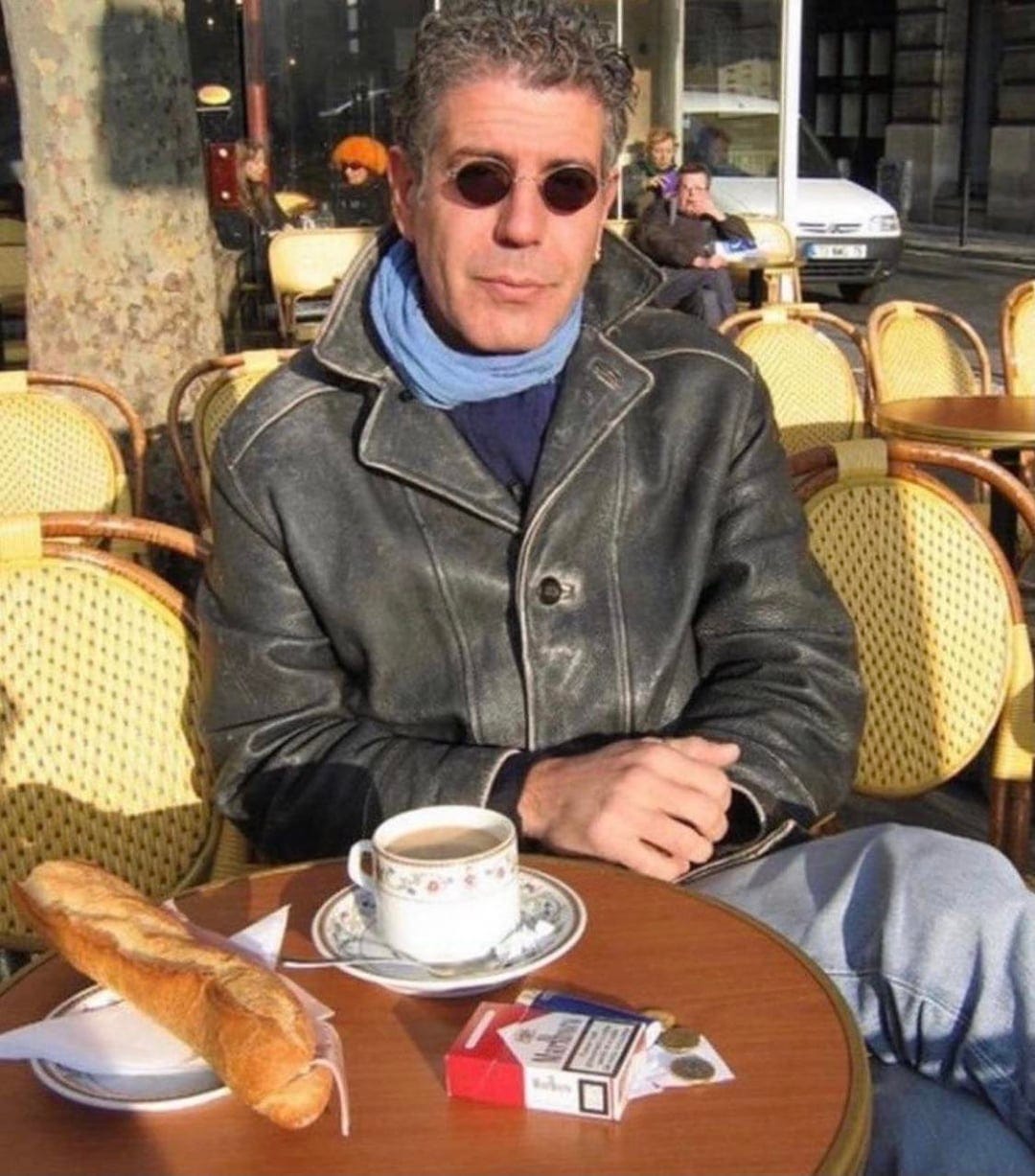
A quick investigation in the Google search bar yields promising indications: 3.3 stars and no working website. Perfect.
This 20th-century relic is nearly as much of a monument as the imposing Église Saint Sulpice across from which it sits. And like the church, the café stubbornly endures despite the vastly changing world around it. The menu, style, and service were calibrated to the consumer preferences of 1965 Paris, the year of the café’s opening, and have never given a second thought. I felt, walking in, as though I had entered a living museum, a chamber of quintessence.
I took my seat in what I call the fishbowl section of café—a kind of four seasons room that extends the indoors into the sidewalk. The diffused daylight of overcast Paris filled the room and the entire vast square with a cool grey hue. Behind me sat a woman who could have been, but certainly wasn’t, Jeanne Moreau, eating her omelette. There it is!
My eyes tracked the menu to the buffet chaud section… Omelette nature, garniture au choix. I ordered mine optioned out: fines herbes, ham, and crucially, Emmental. Bourdain (who famously sat at this café with a pack of cigarettes and a jambon beurre) said that an ounce of sauce covers a multitude of sins. He might have added that cheese is the best insurance policy for an overcooked omelette. That was certainly the case for this one. And apparently, the only fine herb they had in the kitchen was chives.
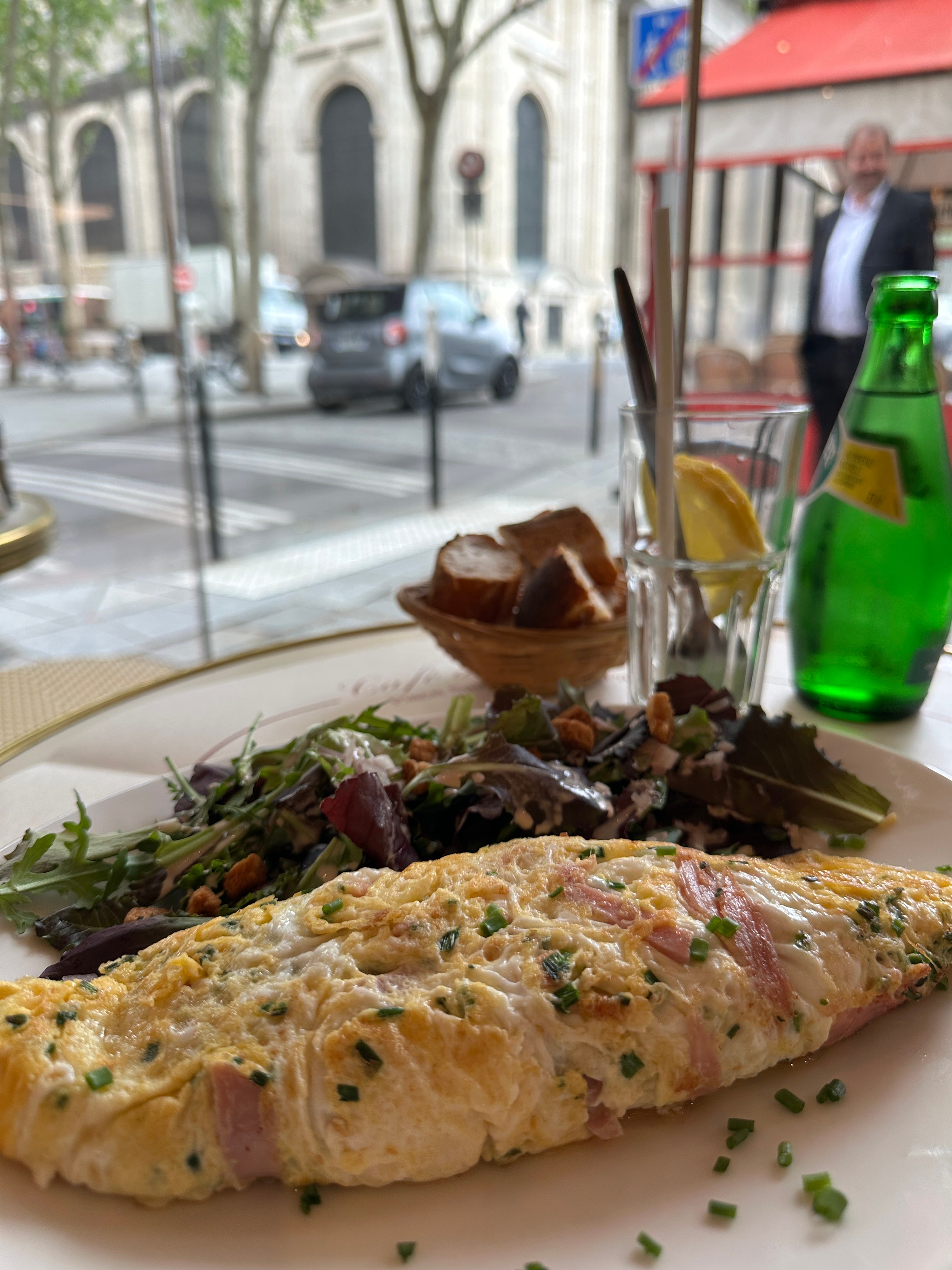
Nevertheless, the first bite ascended me to lunch heaven. The industrial cheese stretched into the air as I pulled away with my fork, enough to make Jeanne Moreau jealous. She stopped the waiter and pointed to me, “Quel est le plat de Monsieur ?”
Le Select
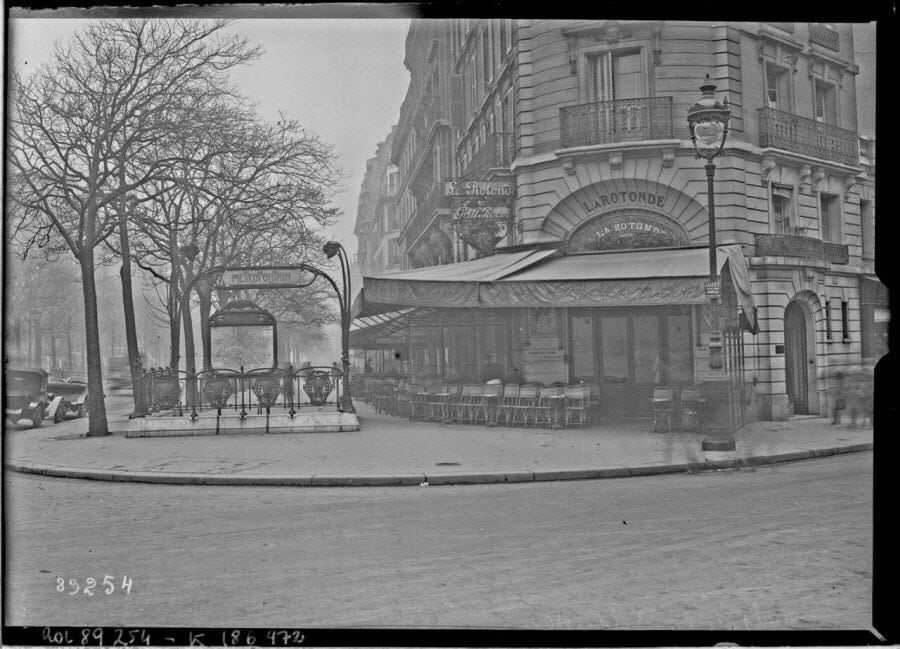
I began to understand that any remaining restaurant omelettes were likely to be hiding in older, let’s say, more conservative areas of Paris. To Montparnasse we go.
I’m referring, of course, neither to the train station nor the tower, widely considered the most eye-grating monstrosity of Paris, but the nearby intersection, the cluster of cafés marked by their respective blazing neon signs.
Most of these cafés have endured for over a century. And a century ago, to frequent one meant you were either bohemian, barely getting by, or both. Today it inarguably means you’re bourgeois. Funny how that works.
On one corner sits Le Dôme, the oldest of the bunch. Peggy Guggenheim (got by just fine, but bohemian nonetheless) used to hang here with her band of struggling artists. Now it’s mostly a place where high-priced crustaceans are crushed by higher-priced veneers attached to tightly tucked faces.
Across the street sits its rival, La Rotonde, where an unknown Amedeo Modigliani would trade drawings for drinks. Today, French President Emmanuel Macron is a regular and a friend of the owner.
I opted for the slightly more discreet Select, featured prominently in the first 80 pages of The Sun Also Rises, as the rowdy watering hole for Hemingway’s lost but spirited cast of characters.
Today’s scene is a far more demure flavor of Parisian Left Bank bourgeoisie. The kind of crowd who’s happy to waste time and money on things they could have faster, better, and less expensively elsewhere. Thorstein Veblen would either have a field day or a heart attack (not that I’ve read even a single word of Thorstein Veblen).
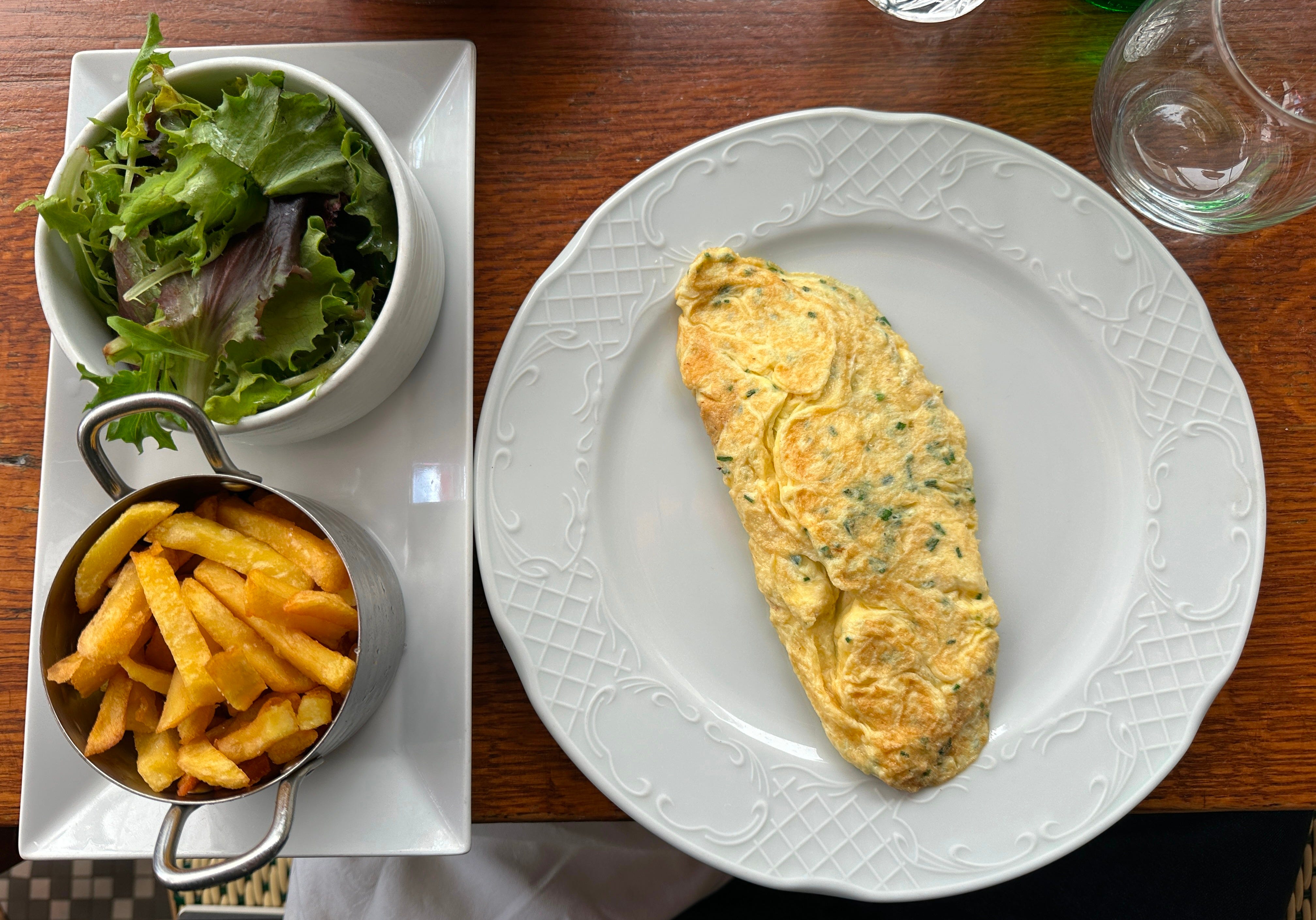
This was reflected in the price of the omelette aux fines herbes: 19 euros for 3 whipped eggs. I, again, sat in the fishbowl section. This time, the waiter asked how I’d like it to be cooked. The omelette came baveuse, as requested, but again only with chives. Why is it that I have more fines herbes in my studio apartment than these cafés do?
Hemingway’s protagonist, Jake Barnes, would come to Le Select to drink away his consciousness and forget his chronic impotence. If ever I come back, it’ll be for the same thing. Not for many decades, I hope.
(Kidding. It’s quite an amusing place. I’ll probably be back sooner for the vibe.)
My posts for the remainder of the year will be frequent and regular, but perhaps not weekly, as I begin working on some bigger video projects.
As always, a thousand thanks to all my paid subscribers. I appreciate your support more than you know.
See you soon,
Max
Thanks for this post. Love your writing, your reviews, and your refusal to provide English translations for your judiciously-used French terms.
The Café de la Mairie used to have a wonderful roast beef salad. I had never seen that anywhere else. Haven’t been there in so long, I don’t know if it’s still on the menu, but your article has tempted me to go back!