

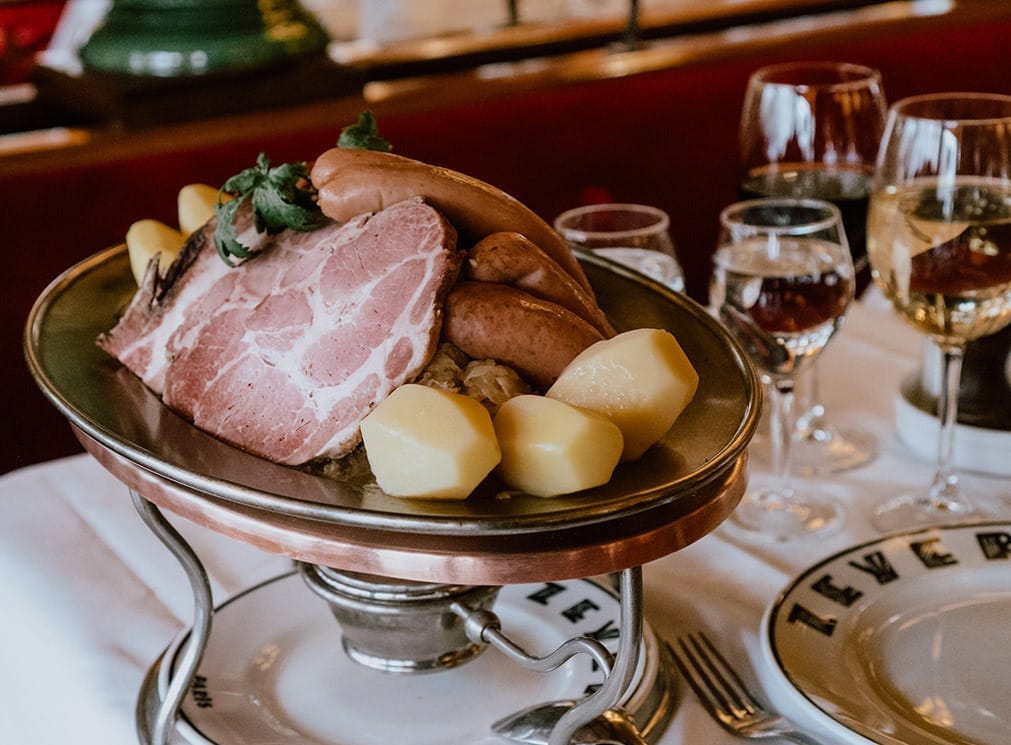
As you peruse the menus of this city’s historic brasseries, you may be shocked to find choucroute, or sauerkraut, featured prominently as a house specialty. “What the hell?” you’d say; “I thought the occupation was over.”
That’s certainly what I thought when I first discovered this bizarro bubble of Parisian cuisine. I intended to move to the Paris of Ratatouille not the Paris of pre-plot Inglorious Bastards. In any case, my German brother-in-law, with whom I was dining at the time, was quite amused by this coincidence. He sported a great big sausage-eating grin as he devoured his hot heap of kraut.
“That’s fine for your brother-in-law, but I came to Paris for French food,” you’ll say. I can understand why you’d hesitate to order sauerkraut in Paris—the same reason you wouldn’t order bouillabaisse in Berlin or jerk chicken in Chang Mai—but in this case that reasoning is faulty. Sauerkraut has been present in Parisian cuisine for centuries; so don’t let guilt or opportunity cost stop you from enjoying pork and fermented cabbage in Paname.
In this article you’ll learn:
How sauerkraut became an authentic Parisian dish
Why you should enjoy some while you’re here
Where to go to find it
German PSYOP, Genghis Khan, Alsatian migrants, or Swiss mercenaries—who brought sauerkraut to Paris?
It is rumored that sauerkraut was originally brought over from China by the Mongolians of the Golden Horde whose conquests reached as far as eastern to central Europe, and that it subsequently became a nutritious staple in Germanic lands. How then did choucroute reach Paris if not via a panzer through the Ardennes?
For the first traces of kraut in la capitale, look no further than Europe’s favorite guns for hire, Swiss mercenaries. French kings as early as François I used private militias from the Germanic cantons (states) of Switzerland as elite royal guards; so sure, that would have given the Swiss guards a few centuries to ferment their cabbage before they were massacred defending Louis XVI, but their influence on France was probably more militaristic than gastronomic (La choucroute, des grandes invasions aux brasseries parisiennes).
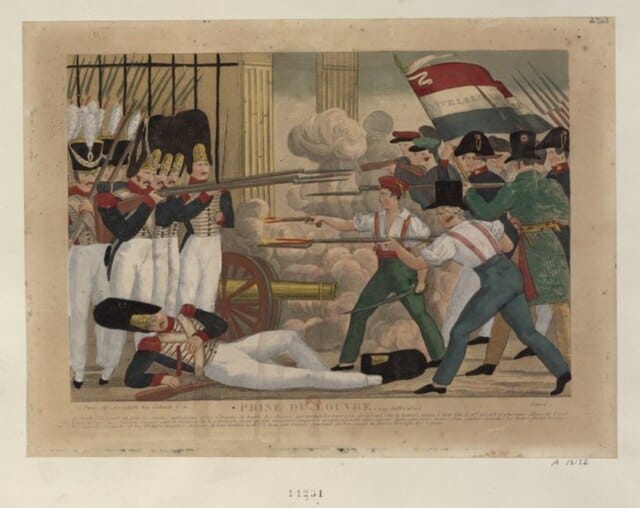
I credit the Alsatian migrants of the 19th century for naturalizing choucroute into Parisian cuisine. In 1870 the French and the Germans decided to settle the debate as to whose sausage was bigger, the boudin or the bratwurst, and the Franco-Prussian War broke out. The poor Alsatians got caught in the middle of that mess and many fled to Paris, taking advantage of a new Strasbourg-Paris railway.
Like so many groups of newcomers, the Alsatians earned money and acceptance in their new home by becoming restaurateurs. They opened their bustling brasseries, a word which actually translates to “brewery,” but, in the world of French restaurants, has taken on a meaning of its own. What began as Paris’s first beer halls evolved over the years into full-service restaurants, with spectacular decor, vast wine lists, and extensive menus of French classics, Alsatian specialties, and, of course, sauerkraut.
Why you should eat sauerkraut in Paris
I’ve already made the case for why choucroute is authentically Parisian, but why does that mean you should forgo a more “classically French” dish?
When in Paris, one simply must experience a traditional brasserie. Just like the old steakhouses of New York, they convey an energy and an ambiance unique to their city. These restaurants are temples of Art Nouveau and Art Deco design, and many are official historic monuments.
Having said that, ordering “French classics” at such establishments has often left me disappointed. That’s because these restaurants do such enormous volume that their kitchens are optimized for quantity over quality.
By ordering choucroute, however, you can taste a piece of Parisian heritage without sacrificing the quality of your meal. That’s because choucroute is the perfect high-volume dish, and many brasseries still prepare it in the traditional fashion, leaving it to stew for hours in Riesling with lard and juniper. All that’s left to do when it comes time to plate is pile on some specialty pork—knuckle, belly, ham, and an assortment of sausages.
Where to eat choucroute in Paris
Bofinger—5-7, rue de la Bastille, 75004 Paris
Established in 1864 by the Alsatian, Frédéric Bofinger, who installed the very first draft beer pump in all of Paris
Decor — Art Nouveau, featuring a breathtaking stained glass cupola in the main dining room
German spy hotspot: “The brasserie run by Bofinger, says our colleague, is a real nest of German spies.” (from the newspaper L’Intransigeant, 2 January 1888—read more in Les Brasseries parisiennes de l’avant-siecle by Gilles Picq)
Known for its delicious choucroute of mammoth proportions
Brasserie Lipp—151 Bd Saint-Germain, 75006 Paris
Established in 1880 by the Alsatian, Léonard Lipp, and originally called la Brasserie des Bords du Rhin, which translates to “the brasserie of the banks of the Rhine”
Decor — Art Nouveau with murals by Charley Garry and ceramics by Léon Fargues
Go for the choucroute au jarret de porc, sauerkraut and pork knuckle
Zeyer—62 rue d’Alesia, 75014 Paris
Established in 1913 by the Alsatian, Marcel Zeyer
Decor — Art Deco imagined by the famous decorator known as Slavik
Serving a variety of choucroute true to its Alsatian heritage
Zeyer remains independent in an age of behemoth restaurant groups
La Coupole—102 Boulevard du Montparnasse, 75014 Paris
Constructed in 1927 not by Alsatians, but by two Auvergnats, Ernest Fraux et René Lafon
Decor — this brasserie is a shrine to Art Deco
By this time, choucroute was such a staple of Parisian brasseries that even non-Alsatians were including it on their menus
Feel free to respond—even just “kraut”—if you enjoyed this week’s newsletter, and share it with your foodie friends.
Click here to read our last newsletter.
See you in a couple weeks,
Max